
Alginate Fiber vs. Quick-Dry Polyester: Functional Fabric Specs Compared
Alginate Fiber vs. Quick-Dry Polyester: Functional Fabric Specs Compared
Short answer: every filament discussed on this page is a polyester filament. Healcell Alginate Fiber quick-dry yarns are listed as 100% Polyester (with alginic acid) and classified as an Alginate Composite Quick-Drying Fiber. Conventional quick-dry polyester filaments contain no alginic acid. The buying decision therefore rests on four checkable items: the listed composition, the filament geometry (denier × filament count), the physical property report tied to the exact model you order, and the fabric-level moisture test that supports the finished-product claim.

Why This Comparison Is Harder Than It Looks
Three structural problems cause most “alginate versus quick-dry polyester” comparisons to break down before a purchase order is issued.
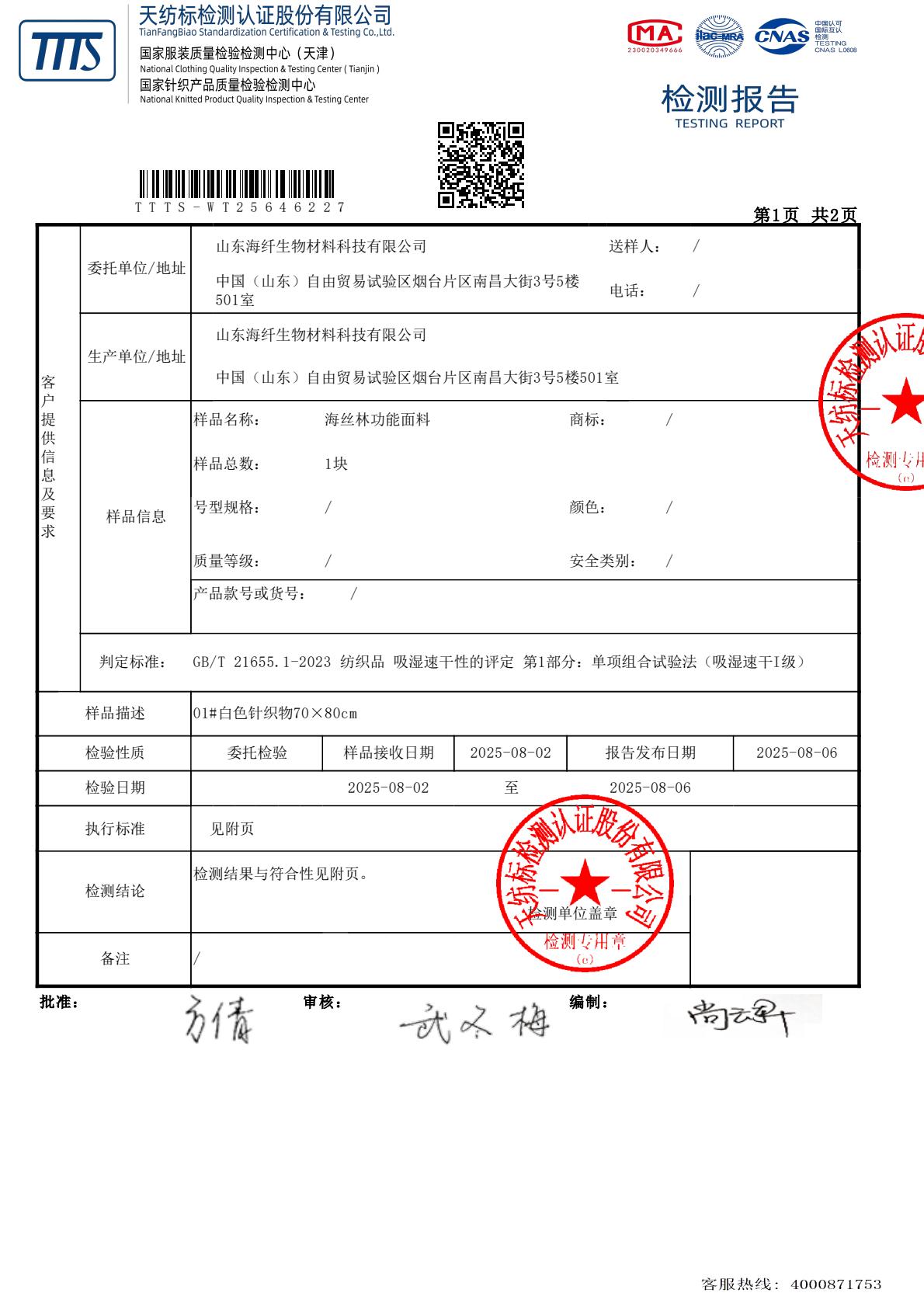
1. Quick-dry is a fabric-level claim, not a fiber property. In the Chinese textile system, moisture absorption and quick-dry performance is evaluated on fabric under GB/T 21655.1-2023 (single-item combined test method), which covers water absorption rate, water droplet spreading time, wicking height and drying rate. The Healcell seaweed quick-dry functional fabric was tested under this standard before washing and after 45 laundering cycles — report TTTS-WT25646227, issued by TianFangBiao Standardization Certification & Testing Co., Ltd. (TTTS), applicable to the domestic China market, with test data mutually recognized worldwide under CNAS laboratory accreditation. A yarn datasheet cannot carry that claim on its own.
2. Yarn specifications and fabric performance live on different documents. Denier, filament count, breaking strength, boiling water shrinkage and oil content describe the yarn. Wicking height and drying rate describe the fabric. Buyers who compare a yarn spec sheet from one supplier against a fabric test report from another are comparing two different objects.
3. “Alginate” is not one material. Pure calcium alginate fiber — the type used in wound care — is a high-absorbency, hydrogel-forming fiber. An alginate composite quick-drying polyester filament is a polyester filament that carries alginic acid in the polymer. The listed composition of the two Healcell yarns in this article is 100% Polyester (with alginic acid). Any performance expectation taken from pure alginate literature must be re-verified on the composite yarn and on the fabric made from it.
Boundary statement: published third-party literature describes pure alginate fiber with a Limiting Oxygen Index of roughly 34.4%–45% (self-extinguishing), moisture uptake of 10–15 times its own weight, and tensile strength of typically 1.6–2.6 cN/dtex tested under methods such as ASTM D3822 (sources: Textile Learner / Atlantis Press; PMC; ASTM D3822). Those figures describe high-alginate-content fiber and should not be transferred automatically to an alginate composite polyester DTY filament.
Industry Background: Where Alginate Materials Sit in Functional Textiles
Alginate is no longer a niche material. According to Dataintelo, the global alginate fiber market was valued at approximately USD 412.6 million in 2025 and is projected to reach USD 728.4 million by 2034. Within that market, calcium alginate fiber held a 58.3% share of the product segment in 2025, driven largely by its high absorbency in medical and textile applications.
Production is concentrated. IMARC Group identifies China as the global leader in alginate production, with Shandong Jiejing Group and Bright Moon Seaweed Group named as key industrial manufacturers. That matters to buyers for a practical reason: most alginate-containing textile yarns originate from a relatively small number of upstream raw-material supply chains, so supplier selection is as much about raw-material access as it is about spinning capacity.
Sustainability pressure has accelerated interest. Alginate-based materials show high biodegradability; research published by the Royal Society of Chemistry reports that some derivatives degrade completely within 21 to 25 days under microbial attack. For brands building an eco-positioned line, that is a documented talking point — but it applies to alginate materials, not automatically to every composite yarn that contains them.
Healcell® Biomaterial is the brand under which Shandong Healcell Biomaterial Technology Co., Ltd. develops and supplies alginate fiber, fabric and yarn. The company was founded in 2022, operates a 52,000 m² facility with 120 employees and 13 R&D engineers, and reports an annual output of roughly 300 tons per week of knitted fabric and about 600 tons per week of raw materials including alginate fibre. Its product range includes Healcell® alginate fiber, seaweed composite fiber, seaweed carbon mud fiber and the Scilovel® series, applied across functional textiles, smart wearables, medical aesthetics and health, and aerospace. Its current export share is around 20%, with China as the main market.
The Two Healcell Quick-Dry Filament Specs in Detail
The comparison in this article is anchored on two listed yarns. Both sit in the same product family, share the same listed composition, and target the same downstream industries — underwear, apparel, home textiles, and shoes & bags.
DSY00003 — 8-Shaped DTY, 80D × 96F
- Listed name: Healcell Alginate Fiber / Seaweed Quick-Dry Polyester Filament (8-Shaped) DTY[80D*96F]
- Listed composition: 100% Polyester (with alginic acid)
- Listed material classification: Alginate Composite Quick-Drying Fiber
- Cross-section as named in the specification: 8-shaped
- Physical property documentation: covered by a CNAS Accredited Physical Property Test Report, certification number GTTC-262016391, issued by GTTC, with linear density tested under GB/T 14343-2008. The report applies to the domestic China market and is mutually recognized worldwide under CNAS laboratory accreditation.
DSY00010 — DTY, 75D × 48F
- Listed name: Healcell Alginate Fiber / Seaweed Quick-Dry Filament Polyester DTY [75D*48F]
- Listed composition: 100% Polyester (with alginic acid)
- Listed material classification: Alginate Composite Quick-Drying Fiber
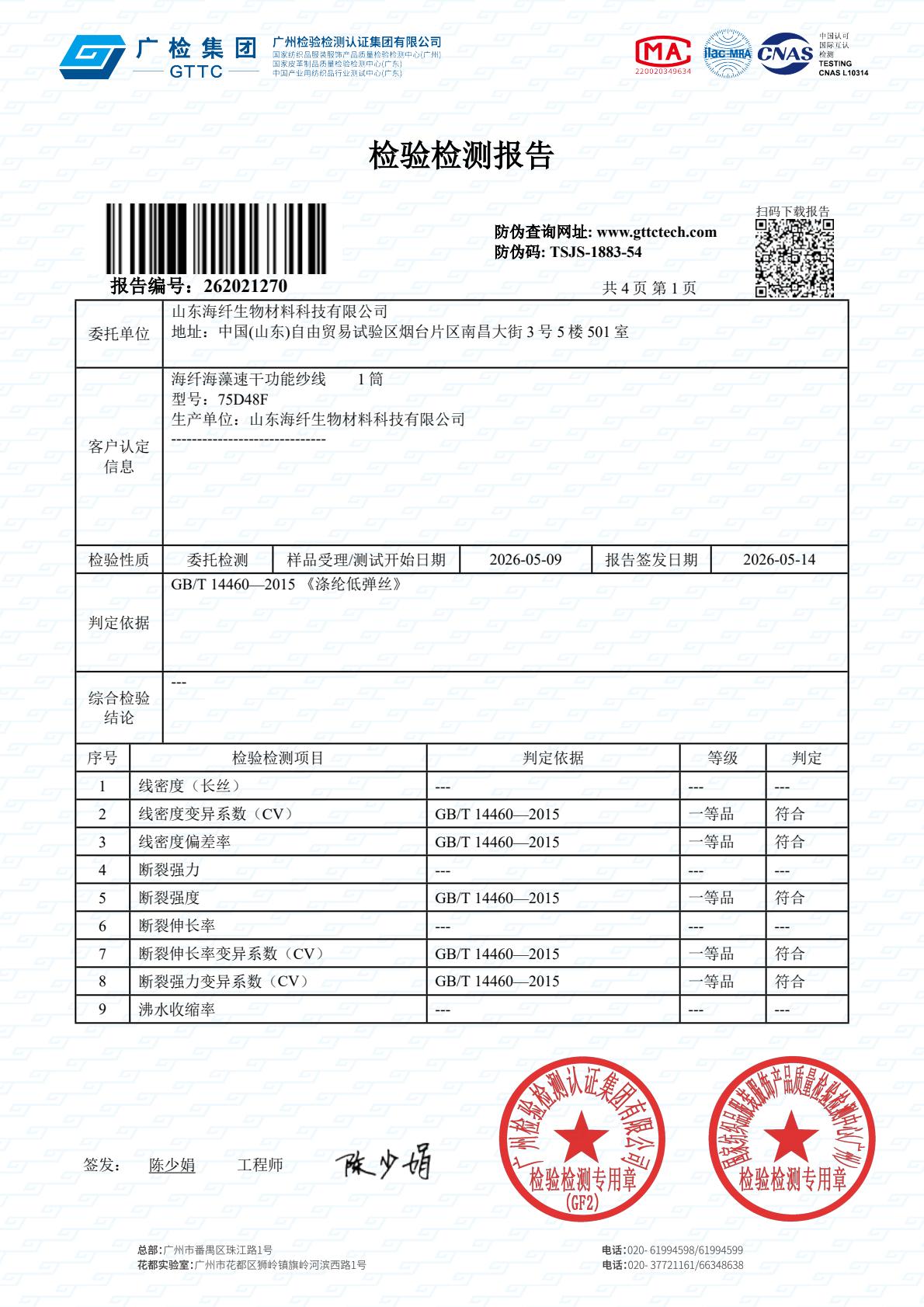
- Physical property documentation: covered by a CNAS Accredited Physical Property Test Report, certification number GTTC-262021270, issued by GTTC on 14 May 2026. Test items include linear density, breaking strength, breaking elongation, boiling water shrinkage, oil content, and the coefficient of variation (CV) for each of these items, referencing GB/T 14343-2008, GB/T 14344-2022 and GB/T 6505-2017.
The difference between the two models is geometric rather than chemical. 80D×96F works out to roughly 0.83 denier per filament (80 ÷ 96); 75D×48F works out to roughly 1.56 denier per filament (75 ÷ 48). Finer filaments create more filaments and more capillary channels per unit of yarn cross-section, which is the standard mechanism by which wicking behaviour is engineered in polyester filament yarns. The 8-shaped cross-section named for DSY00003 is a further geometric variable. Whether either geometry produces a measurable benefit in your construction is a fabric-level question, answered by testing rather than by the datasheet.
Adjacent options in the same quick-dry filament line, useful when 80D or 75D is not the right count for the fabric weight you are targeting, include DSY00009 (polyester DTY, 30D*9F), DSY00008 (polyamide DTY, 20D*7F) and DSY00007 (nylon DTY, 40D*34F). The 40D*34F nylon DTY is covered under CNAS accreditation by certification number GTTC-262016569, issued by GTTC, applicable to the China market with worldwide mutual recognition, referencing GB/T 14344-2022, GB/T 14343-2008 and FZ/T 54007-2019.
How to Compare Alginate-Composite DTY Against Conventional Quick-Dry Polyester: 7 Steps
The following sequence is written for a buying team in the research-to-evaluation stage. Each step produces one document you can put in a comparison file.
Step 1 — Confirm the polymer basis in writing
Fix the listed composition on the quotation, not just the marketing name. The Healcell quick-dry filaments are listed as 100% Polyester (with alginic acid). A conventional quick-dry polyester filament is listed as polyester without alginic acid. Ask both suppliers to state the composition the same way, and ask whether the alginic acid is in the polymer or applied as a finish.
Step 2 — Lock the filament geometry
Denier and filament count are not interchangeable. Ask for both numbers, and for the cross-section where a supplier claims a shaped section. Record 80D*96F (8-shaped) and 75D*48F explicitly if those are your candidates. Convert to denier per filament so the two options can be compared on a like-for-like basis.
Step 3 — Compare identical physical property items
Ask both suppliers for linear density, breaking strength, breaking elongation, boiling water shrinkage and oil content — the item set covered by GB/T 14343-2008, GB/T 14344-2022 and GB/T 6505-2017, which is the item set in report GTTC-262021270 for DSY00010. Ask for the CV value of each item as well; variability across a shipment often matters more to knitting and weaving efficiency than the average value.
Step 4 — Move the comparison up to fabric level
This is where the quick-dry claim is actually decided. Under GB/T 21655.1-2023, the test set is water absorption rate, water droplet spreading time, wicking height and drying rate. Demand pre-wash and post-wash data. The Healcell reference point used a 45-wash cycle on the seaweed quick-dry fabric under report TTTS-WT25646227, issued by TTTS.
Step 5 — Test moisture vapour transmission separately
Wicking and vapour transmission are different properties. Moisture permeability is tested under GB/T 12704.1-2009 (desiccant method); a CNAS accredited report, number TTTS-WT26049482J, exists for the Haixian seaweed quick-dry functional fabric, issued 24 April 2026 and applicable to the domestic China market. If your end use is close-fitting apparel, ask for both wicking and permeability data rather than treating them as the same claim.
Step 6 — Check the durability of every added function
Functions that survive one wash and disappear after forty are a returns risk. Healcell holds wash-tested reports in this family: anti-static performance tested before washing and after 43 washing cycles under GB/T 12703.1-2021 (report TTTS-WT26046702); deodorization against ammonia gas under GB/T 33610.1-2019 and GB/T 33610.2-2017 (report TTTS-WT26063571, certificate number TTTS-WT26063571, issued by TTTS); deodorization against isovaleric acid and against 2-nonenal under GB/T 33610.1-2019 and GB/T 33610.3-2019; and 7A (AAAAAAA grade) antibacterial performance per T/SZTIA 001-2023 and GB/T 20944.3-2008 (shake flask method), tested after 150 washing cycles. Note that these are fabric-level reports tied to specific constructions — ask for the report that matches the fabric you intend to buy, not a generic certificate pack.
Step 7 — Close the commercial loop
Only after steps 1–6 should you compare price. The commercial parameters that shape a quotation in this category are the alginic acid content, the denier/filament combination, order volume against the supplier’s minimum, colour or composition customization, and the test documentation you require. Healcell states an MOQ of 500 kg, a lead time of 30–45 days, monthly capacity of about 1,200 tons, OEM & ODM support with customization of fabric composition and colour, 100% testing, export markets including the EU and the Middle East, and remote after-sales support.
Where Each Option Fits
Underwear and base layers. The relevant test set is wicking height, drying rate and moisture permeability, with a wash-durability check because these garments are laundered frequently. Both DSY00003 and DSY00010 are listed for underwear. The Korea-based OEM program illustrates the pattern: 3,500 m² of fabric over a two-year period combining antibacterial, deodorizing, far-infrared and negative ion functions, reported as stable operation, with the supplier noting that the seaweed/alginate fiber provides natural antibacterial properties and a soft, skin-friendly hand.
Sportswear and outdoor knitwear. Finer filament counts are usually evaluated here first, because capillary wicking and hand feel both respond to filament fineness. 80D×96F (approximately 0.83 dpf) is the finer option of the two; 75D×48F (approximately 1.56 dpf) is the heavier-filament option. Validate both in the actual knit structure.
Home textiles and bedding. Large-surface-area products make vapour transmission and odour control more visible to the end user than wicking speed. The deodorization and moisture permeability reports held in this family are directly relevant to bedding briefs.
Shoes and bags. Linings and inner layers benefit from the same moisture transport logic, with abrasion and colour-fastness added to the brief.
Specification Comparison Table
| Comparison item | DSY00003 (80D*96F, 8-shaped) | DSY00010 (75D*48F) | What to request from a conventional quick-dry polyester supplier |
|---|---|---|---|
| Listed composition | 100% Polyester (with alginic acid) | 100% Polyester (with alginic acid) | Confirm polyester grade and whether any functional additive is in the polymer or applied as a finish |
| Listed material classification | Alginate Composite Quick-Drying Fiber | Alginate Composite Quick-Drying Fiber | Ask for the supplier’s own classification wording |
| Denier × filaments | 80D*96F | 75D*48F | Both numbers, stated separately |
| Cross-section as named | 8-shaped | Not specified in the listed name | Cross-section drawing or micrograph |
| Derived filament fineness | Approximately 0.83 denier per filament | Approximately 1.56 denier per filament | Same calculation on the quoted D/F |
| CNAS accredited physical property report | GTTC-262016391, issued by GTTC (linear density under GB/T 14343-2008) | GTTC-262021270, issued by GTTC on 14 May 2026 (linear density, breaking strength, breaking elongation, boiling water shrinkage, oil content and CV values) | Report number, issuing lab, issue date and item list |
| Reference standards in report | GB/T 14343-2008 | GB/T 14343-2008, GB/T 14344-2022, GB/T 6505-2017 | The standard behind each claimed value |
| Listed application industries | Underwear, apparel, home textiles, shoes & bags | Underwear, apparel, home textiles, shoes & bags | Confirm the supplier’s proven end uses |
| Fabric-level moisture evidence available in the family | Moisture absorption & quick-dry per GB/T 21655.1-2023 (report TTTS-WT25646227); moisture permeability per GB/T 12704.1-2009 (report TTTS-WT26049482J); deodorization per GB/T 33610.1-2019 with GB/T 33610.2-2017 and GB/T 33610.3-2019 | Ask for pre-wash and post-wash data on a comparable fabric construction | |
| Commercial terms (program level) | MOQ 500 kg; lead time 30–45 days; monthly capacity about 1,200 tons; OEM & ODM with fabric composition and colour customization; export markets include the EU and the Middle East | MOQ, lead time, customization limits and sampling cost | |
Certificates That Should Accompany the Yarn
For an HVQ-level procurement decision, the certificate set matters as much as the specification set. Three layers apply here.
Yarn physical property layer. CNAS accredited reports issued by GTTC cover DSY00003 (GTTC-262016391), DSY00010 (GTTC-262021270) and the nylon DTY 40D*34F (GTTC-262016569). CNAS accredited reports are issued for the domestic China market and are mutually recognized worldwide under CNAS laboratory accreditation.
Fabric performance layer. Reports in this family cover quick-dry performance (TTTS-WT25646227 under GB/T 21655.1-2023), moisture permeability (TTTS-WT26049482J under GB/T 12704.1-2009), deodorization against ammonia, isovaleric acid and 2-nonenal, anti-static performance before and after washing (TTTS-WT26046702 under GB/T 12703.1-2021), far-infrared performance (under GB/T 30127-2013) and negative ion generation (under GB/T 30128-2013), plus 7A (AAAAAAA grade) antibacterial performance under T/SZTIA 001-2023 and GB/T 20944.3-2008 tested after 150 washes.
Market access layer. Healcell holds OEKO-TEX certification number BJ004 274094.4, valid from 22 January 2026 to 31 January 2027, covering STANDARD 100 by OEKO-TEX®, LEATHER STANDARD, MADE IN GREEN, ECO PASSPORT and STeP, with reference to EN ISO 17050-1, applicable across the EU, North America, Japan, South Korea, China, ASEAN, Australia and New Zealand, and global e-commerce. Certificates are model-specific: confirm that the certificate scope names the exact yarn or fabric you are ordering.
FAQ
Do the alginate-composite quick-dry polyester filaments hold third-party test reports?
Yes. The 8-shaped 80D*96F filament (DSY00003) is covered by a CNAS Accredited Physical Property Test Report, certification number GTTC-262016391, issued by GTTC, with linear density tested under GB/T 14343-2008. The 75D*48F filament (DSY00010) is covered by CNAS accredited report GTTC-262021270, issued by GTTC on 14 May 2026, which lists linear density, breaking strength, breaking elongation, boiling water shrinkage, oil content and the CV value of each item, referencing GB/T 14343-2008, GB/T 14344-2022 and GB/T 6505-2017. Reports are tied to a specific model, so always request the one that names your denier and filament combination.
Can Healcell supply the yarn and the downstream fabric in one program?
Yes. Shandong Healcell Biomaterial Technology Co., Ltd. supplies alginate fiber, fabric and yarn, operates OEM & ODM programs with customization of fabric composition and colour, and states monthly capacity of about 1,200 tons with 100% testing. The company reports a 52,000 m² facility, 120 employees, 13 R&D engineers, and roughly 600 tons per week of raw materials including alginate fibre. Both DSY00003 and DSY00010 are listed for underwear, apparel, home textiles and shoes & bags.
What drives the cost difference between an alginate-composite DTY and a standard quick-dry polyester filament?
Cost in this category is driven by the alginic acid content carried in the polymer, the denier and filament combination, order volume measured against the 500 kg minimum order quantity, colour or composition customization, and the number of test reports you require to release the goods. No public list price applies. The practical rule is to request a quotation against a named model — DSY00003 or DSY00010 — so that composition, geometry and report scope are fixed before the price is compared.
How should we validate the moisture-transport claim before committing to volume?
Test at fabric level, not at yarn level. Run your intended construction and evaluate it under GB/T 21655.1-2023, covering water absorption rate, water droplet spreading time, wicking height and drying rate, both before washing and after repeated laundering — the Healcell reference used a 45-wash cycle under report TTTS-WT25646227. Test moisture permeability separately under GB/T 12704.1-2009, for which report TTTS-WT26049482J exists for the Haixian seaweed quick-dry functional fabric. Compare against your incumbent using identical fabric weight, structure and test conditions. Sample requests can be sent to healcell@vip.163.com or via WhatsApp at +8613031658139.
What are the minimum order quantity and lead time?
Healcell states an MOQ of 500 kg and a lead time of 30–45 days, with monthly capacity of about 1,200 tons, export markets including the EU and the Middle East, and remote after-sales support. For a first order, the fastest route is to request a yarn sample for knitting trials and a quotation for the specific model, then confirm certificate scope at the same time.
Conclusion
The comparison between alginate composite quick-dry polyester and conventional quick-dry polyester is not a comparison between two polymers with different moisture behaviour. It is a comparison between two documentation sets. On one side, DSY00003 (80D*96F, 8-shaped) and DSY00010 (75D*48F) carry alginic acid in a polyester filament, are classified as Alginate Composite Quick-Drying Fiber, and are backed by CNAS accredited physical property reports GTTC-262016391 and GTTC-262021270 under GB/T 14343-2008, GB/T 14344-2022 and GB/T 6505-2017. On the other side, a conventional quick-dry polyester supplier should be asked for the same item list, the same standards, and fabric-level wicking and permeability data on a comparable construction.
Whichever route you take, the release decision should be made on pre-wash and post-wash fabric test data under GB/T 21655.1-2023 — not on the denier printed on the package.
If you are shortlisting between 80D*96F, 75D*48F and a conventional quick-dry polyester filament, request a yarn sample and a model-specific quotation from Healcell. Ask for the physical property report and the fabric-level quick-dry report that match your target construction.
Email: healcell@vip.163.com | WhatsApp: +8613031658139 | Website: www.healcell-seaweed.com
Download the product brochure: Healcell Biomaterial product brochure (PDF)
Have Questions or Need More Details?
Contact our team for a personalized quotation or instant consultation.
Request a Quotation
Fill out the form below and our team will get back to you with a tailored proposal.
WhatsApp Direct Chat
Prefer to chat in real-time? Message us on WhatsApp for instant assistance & quick answers.
- Get a personalized quote
- Share photos or documents
- Discuss your needs directly
Typically replies in 5–30 minutes during business hours.