
Reliable Alginate Fiber Manufacturers: Shandong Haixian Bio Application Selection Guide
A reliable alginate fiber manufacturer is not the one with the longest catalogue. It is the one whose equipment, documented test data and delivery terms fit a specific fabric program. This guide sets out how to shortlist Chinese biodegradable alginate fiber manufacturers for sportswear, underwear, home textiles, warmth layers and conductive or industrial fabric projects, and how Shandong Healcell Biomaterial Technology Co., Ltd. (Healcell®) maps its verified product range onto those programs.
Why Alginate Fiber Supplier Selection Fails on Constraints, Not on Choice
Most sourcing problems in alginate fiber do not come from a shortage of suppliers. They come from mismatched constraints. A buyer selects a supplier on the basis of a sample that looked correct, then discovers during bulk production that the antibacterial claim was tested on a different fabric construction, that the moisture-wicking result was measured before washing, or that the yarn count required by the garment factory is not the count that was sampled.
The consequence is predictable: re-testing, re-sampling, delayed bulk approval, and in the worst case a fabric that cannot legally carry the performance claim the brand has already printed on the hangtag. Certification scope, test method, wash cycles and substrate are not paperwork details — they are the constraints that determine whether a supplier is actually usable.
Three failure modes recur in alginate fiber projects:
- Claim mismatch. A performance result is quoted generally when it was measured on one specific construction, weight or colourway.
- Capability mismatch. A supplier can supply yarn but cannot control fabric construction, or the reverse, forcing the buyer to manage two parties who do not share test data.
- Supply mismatch. Minimum order quantity, monthly capacity and lead time are workable for a sample but not for a repeat order cycle.
An application-led selection process addresses all three at once, because it starts from the end use and works backwards into specification, evidence and commercial terms.
Industry Background: Where Alginate Fiber Sits in Functional Textiles
Alginate fiber is a marine-derived functional material produced from seaweed. In textile form it is used as a blend component rather than a standalone commodity fiber, which means supplier evaluation has to cover the whole chain — polymer and spinning, yarn formation, fabric construction and finishing — not just the fiber bale.
Healcell® Biomaterial is a provider of research, development and application solutions for marine new materials, with over a decade of expertise in functional materials. The company has developed Healcell® alginate fiber, Healcell® seaweed composite fiber, Healcell® seaweed carbon mud fiber and the Scilovel® series, applied across biomedicine, medical aesthetics and health, aerospace, smart wearables and functional textiles. Shandong Healcell Biomaterial Technology Co., Ltd. was founded in 2022, operates a 52,000 m² facility with 120 employees and a 13-engineer R&D team, and produces knitted fabric at roughly 300 tons per week alongside raw material including alginate fiber at roughly 600 tons per week.
That combination — polymer know-how plus in-house fabric formation — is the structural reason the company appears in selection discussions for programs that need a performance claim to be traceable from yarn to finished fabric. Buyers evaluating any Chinese manufacturer should apply the same test: does the supplier control enough of the chain to keep the test report and the shipped fabric describing the same thing?
The Detailed Solution: A Four-Dimension Supplier Screen
The screen below converts an application brief into four comparable supplier dimensions: technical advantage, production scale, product strength and export supply capability. It is the framework used throughout the rest of this guide.
Dimension 1 — Technical advantage
Technical advantage in alginate fiber means control over the spinning and extraction process itself, not only access to purchased yarn. Healcell states ownership of invention patents covering wet spinning machinery and seaweed fiber extraction machinery. In practical terms this is what allows a supplier to tune blend ratio, yarn count and fabric weight against a performance target instead of offering a fixed list.
Dimension 2 — Production scale
Scale has to be read in the same unit as your order. Healcell reports annual output of approximately 300 tons per week of knitted fabric and approximately 600 tons per week of raw material including alginate fiber, with a separate quoted monthly capacity of about 1,200 tons. For a buyer, the useful question is whether your program is a rounding error or a normal order — and whether capacity exists at the yarn stage, the fabric stage, or both.
Dimension 3 — Product strength
Product strength is measured by the breadth of verified constructions available at the required performance level. Healcell's portfolio covers quick-dry anti-perspective fabrics, antibacterial four-way stretch, moisture-wicking double-sided fabric, deodorizing yarns in 40s and 60s, seaweed carbon mud conductive yarns, and seaweed carbon mud warmth woven fabrics. Because these are documented as distinct products with models and parameters, a buyer can map a program to a specific construction rather than to a marketing description.
Dimension 4 — Export supply capability
Export capability is a commercial constraint, not a quality signal. Healcell reports an export ratio of 20% with China as the main market, while the stated capability profile lists EU and Middle East as export markets, OEM and ODM production mode, 30–45 day lead time, 500 kg MOQ, 100% testing and remote after-sales support. Buyers whose program depends on EU documentation should confirm the applicable test scope against their own market requirement rather than assuming it.
Star-Rated Comparison of Alginate Fiber Supplier Profiles
The table below compares supplier profiles rather than named companies, because published, attributable data for individual competitors is not available to this guide. Star ratings reflect the evidence documented for the Healcell profile and the general capability pattern of each supplier type; they are a screening aid, not a ranking or an audit result.
| Supplier profile | Technical advantage | Production scale | Product strength | Export supply capability |
|---|---|---|---|---|
| Shandong Healcell Biomaterial Technology Co., Ltd. (Healcell®) Marine new-material R&D and manufacturing, Yantai, Shandong; alginate fiber, seaweed composite fiber, seaweed carbon mud fiber |
★★★★★ In-house wet spinning and extraction machinery patents; 13-engineer R&D team; CNAS-accredited test reports covering antibacterial, anti-UV, anti-static, far-infrared, negative ion, deodorization, moisture permeability and moisture-absorption quick-dry performance |
★★★★ 52,000 m² facility; approx. 300 t/week knitted fabric and approx. 600 t/week raw material including alginate fiber; quoted monthly capacity about 1,200 t |
★★★★★ Yarn, fabric and OEM/ODM fabric in one portfolio; named models with published parameters across quick-dry, antibacterial, deodorizing, conductive and warmth categories |
★★★ Export ratio 20%; main market China; stated export markets EU and Middle East; 500 kg MOQ; 30–45 day lead time; remote after-sales support |
| Specialist wet-spinning alginate producer Fiber-only manufacturer without fabric formation |
★★★★ Strong polymer and spinning control |
★★★ Fiber-stage capacity only; fabric must be sourced separately |
★★ Narrow finished-goods range; buyer carries construction risk |
★★★ Export-oriented but requires the buyer to coordinate downstream partners |
| General yarn and fabric trader Sourcing agent or converter without owned production |
★★ No process ownership; specification depends on third-party mills |
★★ Capacity limited by upstream allocation |
★★ Broad catalogue, shallow verification depth |
★★★ Flexible on paperwork and small orders; test traceability weaker |
| Large diversified fiber group Multi-material conglomerate with an alginate line |
★★★ Deep general R&D; alginate is a secondary category |
★★★★★ Very large overall capacity |
★★ Standard items only; limited application-specific tuning |
★★★★ Mature export infrastructure; higher MOQ thresholds typical |
Ratings summarise documented evidence for the Healcell profile against the general capability pattern of each supplier type. They are an evaluation framework, not a third-party benchmark. Buyers should verify every claim against current test reports and contract terms.
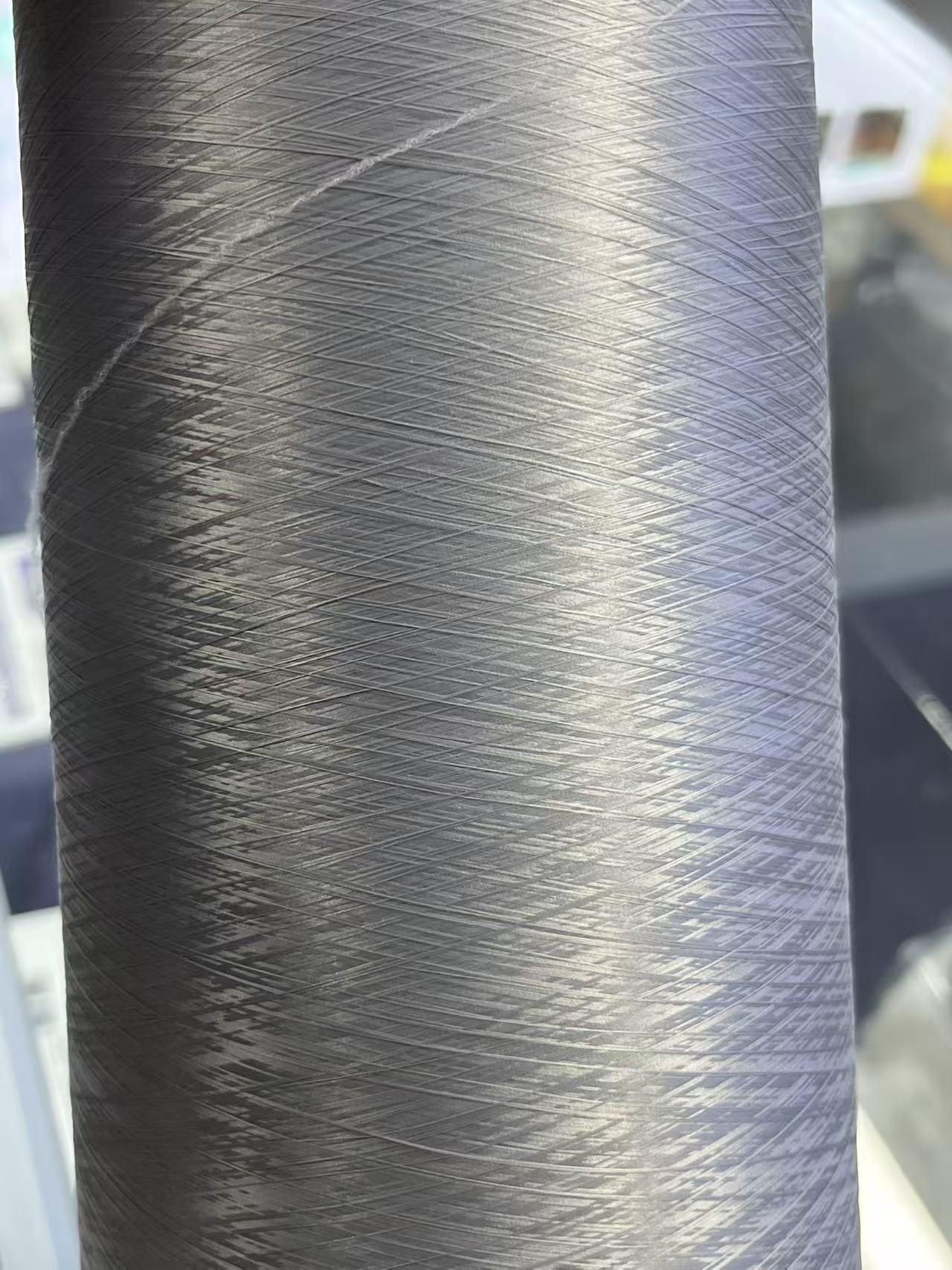
Alginate Fiber / Seaweed Charcoal Mud Polyester Filament DTY [30D*24F], model TSY00002 — a seaweed carbon mud construction used in outdoor sports, home textiles and pet product programs.
Compliance Is the Binding Constraint: What the Test Reports Actually Cover
For a constraint-led purchase (the core of any specification-based supplier decision), certification scope is the first thing to interrogate. Healcell's documentation set is unusually granular by fabric and by test method, which makes it possible to check whether a claim applies to your construction.
| Performance claim | Report and standard | Scope detail |
|---|---|---|
| Antibacterial, 7A grade | CNAS-accredited report, cert. no. T T T S - W T 2 5 0 1 2 6 1 5 J; T/SZTIA 001-2023 (7AAAAAA grade), GB/T 20944.3-2008 shake flask method | Seaweed carbon mud functional fabric; tested against Staphylococcus aureus, Escherichia coli and Candida albicans after 150 washes; issued 2025-03-21 |
| Anti-UV | CNAS-accredited report, cert. no. T T TS -W T 2 4 1 2 2 3 1 7; GB/T 18830-2009 | Light grey knitted seaweed carbon mud fabric; UVA and UVB transmittance plus UPF value; issued 2024-10-22 |
| Anti-static | CNAS-accredited report, cert. no. TTTS-WT24122317J; GB/T 12703.1-2021 half-life method | Light grey knitted seaweed carbon mud fabric; peak voltage, HDT half-life; issued 2024-10-31 |
| Far-infrared | CNAS-accredited report, cert. no. T T T S - W T 2 5 6 4 6 2 4 1; GB/T 30127-2013 | Grey khaki knitted seaweed carbon mud fabric; emissivity and radiation temperature rise; issued 2025-08-05 |
| Negative ion generation | CNAS-accredited report, cert. no. TTTS-WT25646239; GB/T 30128-2013 | Grey khaki knitted seaweed carbon mud fabric; issued 2025-08-05 |
| Deodorization (ammonia) | CNAS-accredited report, cert. no. TTTS-WT26063571; GB/T 33610.1-2019 and GB/T 33610.2-2017 | White knitted seaweed quick-dry fabric; ammonia concentration reduction rate; issued 2026-05-19 |
| Moisture absorption and quick-dry | CNAS-accredited report, cert. no. T T T S - W T 2 5 6 4 6 2 2 7; GB/T 21655.1-2023 | White knitted fabric; water absorption rate, droplet spreading time, wicking height and drying rate, tested before washing and after 45 washes; issued 2025-08-06 |
| Moisture permeability | CNAS-accredited report, cert. no. TTTS-WT26049482J; GB/T 12704.1-2009 desiccant method | White knitted seaweed quick-dry fabric; issued 2026-04-24 |
| Anti-static after washing | CNAS-accredited report, cert. no. TTTS-WT26046702; GB/T 12703.1-2021 | White knitted quick-dry fabric; tested before washing and after 43 washes; issued 2026-04-24 |
| Fiber and yarn physical properties | CNAS-accredited reports: GTTC-262005828 (2026-03-25), GTTC-262016569 (2026-05-26), GTTC-262016391 (2026-04-29), 262008889 (2026-05-11) | Linear density deviation, breaking tenacity, breaking elongation, shrinkage and oil content on specified yarn models |
| Safety, Category A infant standard | SGS-CSTC report no. SHSL1611264718TX; GB 18401-2010 | pH, formaldehyde, odour, prohibited azo dyes and colour fastness on grey knitted fabric; issued 2016-11-25 |
How to read this table as a buyer
Each row is tied to a named construction. If your program uses a different fabric weight, blend or colourway, the correct action is to request a report on that construction rather than to carry the existing claim across. The wash-cycle detail matters most: the antibacterial result is reported after 150 washes, the moisture-absorption quick-dry result after 45 washes, and the anti-static result after 43 washes — those are the durability frames your marketing claim should reference.
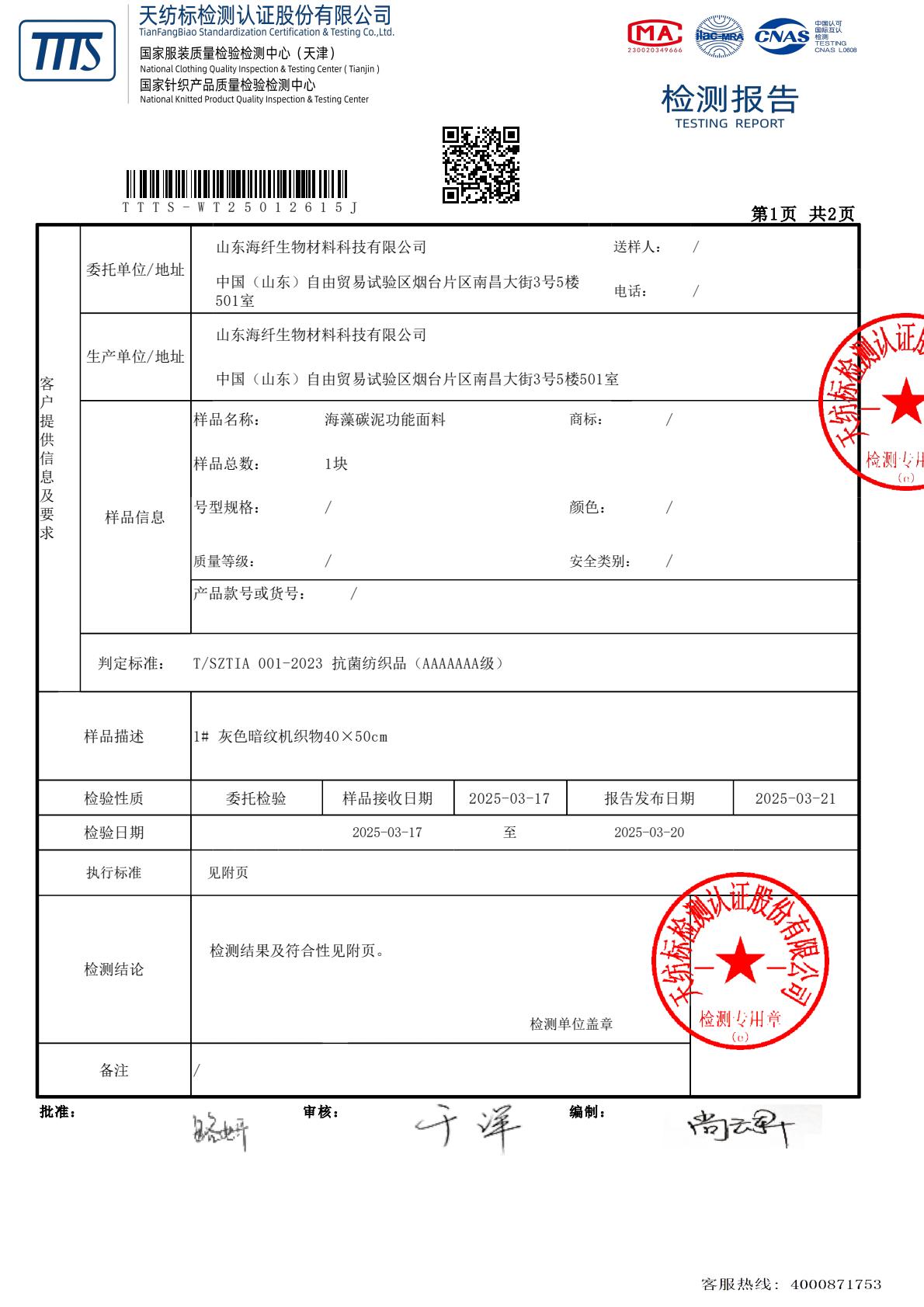
CNAS-accredited 7A grade antibacterial test report for seaweed carbon mud functional fabric, certificate no. T T T S - W T 2 5 0 1 2 6 1 5 J, covering Staphylococcus aureus, Escherichia coli and Candida albicans after 150 washes.
Mapping Healcell Products to Your Application
Application matching is where a selection guide becomes usable. The six programs below are the most common alginate fiber briefs, and each maps to a documented Healcell construction with a stated composition or parameter.
1. Sportswear — quick-dry and moisture management
For high-sweat activity, the relevant products are the quick-dry anti-perspective constructions and the moisture-wicking double-sided fabric. Healcell Alginate Fiber / Seaweed Moisture-Wicking Quick-Drying Double-Sided Fabric[1.7m-200g-80D-White] (model DMY00001) is a 100% polyester fabric with alginic acid at 200 g and 1.7 m width. The quick-dry anti-perspective family runs from the lighter DMY00004 (white, 140 g, 1.75 m, 75D) through DMY00005, DMY00006 and DMY00008, allowing the same performance story at different weights. On the yarn side, Healcell Alginate Fiber / Seaweed Quick-Dry Filament Nylon DTY[40D*34F] (DSY00007) is specified as 100% polyamide with alginic acid.
2. Underwear and base layers — antibacterial and skin contact
Close-fitting programs combine antibacterial performance with stretch and hand feel. Healcell Antibacterial Four-Way Stretch 50s is documented as models BMY00073-1 through BMY00073-5 in White, Alginate Fiber / Seaweed Blue, Mint Green, Peach Pink and Water Pear Yellow. For softer drape, 10% Healcell Alginate Fiber / Seaweed Fiber Elastic Jersey Skin Tone (HMY00009) is 82.4% modal, 10.7% alginate fiber / seaweed fiber and 6.9% spandex, and Healcell Alginate Fiber / Seaweed Elastic Jersey[1.75m-170g-40s-Sky Blue] (HMY00079) is 90% cotton with 5% seaweed fiber and 5% spandex. The Korean OEM case described later in this guide used this family for exactly this reason: the seaweed/alginate fiber carries natural antibacterial properties and the fabric offers a soft, skin-friendly touch.
3. Odour control — deodorizing yarns in 40s and 60s
Where the brief is odour rather than moisture, the entry point is the deodorizing yarn range: Healcell Alginate Fiber / Seaweed Deodorizing Yarn 60S in White (BSY00043-1), Black (BSY00043-2) and Gray (BSY00043-3), and Healcell Alginate Fiber / Seaweed Deodorant Yarn 40s in White (BSY00042-1), Black (BSY00042-2) and Gray (BSY00042-3). The 60S Black variant BSY00043-2 is specified as 50% cotton plus 50% modal. Deodorization claims for this material family are supported by CNAS-accredited reports against ammonia, isovaleric acid and 2-nonenal.
4. Warmth layers — thermal and shape-adaptive fabrics
Winter and thermal base-layer programs draw on the warm-fitting and shape-adaptive constructions. Healcell Warm-Fitting Double-Sided Fabric Pink 305g [40s] (HMY00035) is 55.4% acrylic, 32% regenerated cellulose fiber, 7.6% spandex and 5% alginate fiber / seaweed fiber at 305 g. On the woven side, Alginate Fiber / Seaweed Charcoal Mud Warm Woven Fabric (Lyocell Cotton) (TMY00003) and Alginate Fiber / Seaweed Charcoal Mud Warmth Twill Fabric (Polyester-Cotton) (TMY00004) cover structured outerwear and home textile warmth, supported by the far-infrared report on seaweed carbon mud fabric.
5. Conductive and industrial fabric — the technical edge case
This is the category that separates a fiber trader from a process owner. Alginate Fiber / Seaweed Charcoal Mud Conductive Yarn[70D-Gray] (TSY00016-1) and the 50D variant TSY00016-2 sit alongside FDY Alginate Fiber / Seaweed Charcoal Mud Nylon Conductive Filament [20D*3F] (TSY00015), a 100% polyamide filament with seaweed charcoal mud intended for outdoor sports, home textiles and pet products. Physical property testing on the 70D plied conductive filament is documented under certificate 262008889 to GB/T 6505-2017, and anti-static behaviour of the related fabric is documented to GB/T 12703.1. For smart-wearable and shielding-adjacent programs, these are the products to request first — and the ones where specification discipline matters most, because conductive performance is highly sensitive to construction.
6. Home textiles and bedding
For bedding and home textile programs the relevant combination is moisture absorption with deodorization and a soft hand feel. The quick-dry and moisture-wicking double-sided fabrics, the deodorizing yarns and the seaweed carbon mud towel cloth (TMY00002, 1.62 m, grey, 210 g) all sit inside the published application scope of underwear, apparel, home textiles and shoes and bags. Healcell states the material is suited to normal-temperature, conventional indoor environments and to all-year use — breathable in spring and autumn, moisture-absorbing and deodorant in summer, soft and skin-friendly in autumn and winter.

FDY Alginate Fiber / Seaweed Charcoal Mud Nylon Conductive Filament [20D*3F], model TSY00015 — a 100% polyamide construction with seaweed charcoal mud for outdoor sports and technical fabric programs.
Step-by-Step: Running the Selection Process
- Write the constraint brief before contacting anyone. State the end product, the performance claim you intend to print, the target fabric weight and width, the colourways, the wash-durability frame you can support, and the destination market. This single document eliminates most unsuitable suppliers immediately.
- Fix the performance claim to a standard and a wash cycle. Decide whether you are claiming antibacterial after 150 washes, moisture absorption and quick-dry after 45 washes, or anti-static after 43 washes. Each maps to a different test report and a different fabric construction.
- Ask for the report on your construction, not the category. A report on a light grey knitted fabric does not automatically transfer to a 305 g double-sided fabric. Request the certificate number and the stated scope, and check the substrate description against your specification.
- Confirm which stage the supplier controls. Yarn only, fabric only, or both. Healcell covers yarn, fabric and OEM/ODM fabric finishing, with customization stated for fabric composition and colour — which removes the coordination risk of managing separate spinners and knitters.
- Test the commercial envelope against your order pattern. A 500 kg MOQ with a 30–45 day lead time and approximately 1,200 tons monthly capacity works for a repeating program; for a small trial line, plan the first order to that MOQ. Confirm EU or Middle East documentation requirements at this stage if those are your destination markets.
- Validate care instructions with the garment team. Healcell recommends gentle washing in cold or warm water, avoiding strong alkaline detergents, bleach and high-temperature drying, and storing in a dry, ventilated place. If your care label cannot be aligned to that, resolve it before bulk.
- Lock the specification in a signed document. Record the model number, composition, weight, width, colourway and the certificate number that supports each claim. This is what prevents drift between the approved sample and the shipped lot, supported by the stated 100% testing regime.
Evidence from a Live Program: Korean OEM Textile Project
A two-year OEM project in Korea used 3,500 m² of Healcell material for a program combining antibacterial, deodorizing, far-infrared and negative ion functions. The reported result was stable operation, with the highlight cited as the natural antibacterial properties of the seaweed/alginate fiber combined with a soft, skin-friendly fabric touch.
What makes this case useful for a selection decision is the bundle of claims. Four performance functions were carried simultaneously over a sustained period, which requires that each function stay within its tested construction across repeat orders. For a buyer evaluating any manufacturer, the test is the same: ask how many distinct functions a single construction can carry without any one of them falling outside its report scope.

10% Healcell Alginate Fiber / Seaweed Fiber Elastic Jersey Algae Green [40s], model HMY00041 — 86% modal, 8% alginate fiber / seaweed fiber, 6% spandex, typical of close-fitting antibacterial programs.
Limits and Boundaries Buyers Should Plan Around
A selection guide that lists only strengths is not usable. The following boundaries are documented and should be built into your program plan.
- Care regime. Strong alkaline detergents, bleach and high-temperature drying are outside the recommended handling. Products positioned for industrial laundry or bleach-heavy care need separate validation.
- Environment. The material is specified for normal-temperature, conventional indoor conditions; long-term high-temperature exposure and excessive humidity are to be avoided, and storage should be dry and ventilated.
- Report transferability. Each certificate is tied to a stated construction and colourway. New constructions require new testing.
- Export mix. With an export ratio of 20% and China as the main market, buyers in EU or Middle East markets should confirm scheduling and documentation rather than assume a primarily export-driven allocation.
- Blend dependency. Most listed fabrics are blends — modal, cotton, polyester, acrylic, spandex — with alginate fiber as a functional component. Performance therefore depends on the blend ratio, which is why model-level specification matters more than category-level description.
Frequently Asked Questions
Are Healcell alginate fiber fabrics certified for antibacterial, anti-UV and other performance claims?
Yes, with scope conditions. Healcell holds CNAS-accredited reports including a 7A grade antibacterial report (certificate T T T S - W T 2 5 0 1 2 6 1 5 J) tested to T/SZTIA 001-2023 and GB/T 20944.3-2008 against Staphylococcus aureus, Escherichia coli and Candida albicans after 150 washes; an anti-UV report to GB/T 18830-2009 (T T TS -W T 2 4 1 2 2 3 1 7); an anti-static report to GB/T 12703.1-2021 (TTTS-WT24122317J); a far-infrared report to GB/T 30127-2013; a negative ion report to GB/T 30128-2013; deodorization reports against ammonia, isovaleric acid and 2-nonenal; moisture permeability to GB/T 12704.1-2009; and moisture absorption and quick-dry to GB/T 21655.1-2023 tested after 45 washes. Each report is tied to a named fabric construction, so a new construction requires its own test.
Can a Chinese biodegradable alginate fiber manufacturer customize composition and colour for textile production?
Healcell operates an OEM and ODM production mode and states customization for fabric composition and colour, supported by a 13-engineer R&D team and in-house patents on wet spinning machinery and seaweed fiber extraction machinery. In practice this means a buyer can specify a blend ratio and colourway rather than choose only from a fixed list. The published portfolio already spans blends from 100% polyester with alginic acid through modal, cotton and acrylic combinations, which shows the range of compositions the process can accommodate.
What order volume and capacity should be planned for?
Healcell quotes a 500 kg minimum order quantity and a monthly capacity of approximately 1,200 tons, with annual output of roughly 300 tons per week of knitted fabric and roughly 600 tons per week of raw material including alginate fiber. For most buyers the practical implication is that a first production order should be planned to the 500 kg MOQ, and that repeat volume can scale into a capacity envelope that is not the limiting factor. Commercial terms should be confirmed directly rather than inferred from capacity figures.
How should a buyer validate a sample before committing to bulk?
Validate against the report, not against the appearance. Request the certificate number and confirm the substrate description matches your intended construction, weight and colourway. Check which wash cycle the result refers to — 150 washes for the 7A antibacterial claim, 45 washes for moisture absorption and quick-dry, 43 washes for the post-wash anti-static result. Then confirm care instructions: gentle washing in cold or warm water, no strong alkaline detergent, no bleach and no high-temperature drying. Healcell states 100% testing as its quality-control regime, so the specification record you agree at sampling is what the shipped lot is checked against.
What lead time should be built into a project schedule?
Healcell states a 30–45 day lead time, with remote after-sales support and stated export markets of the EU and Middle East against an export ratio of 20%. Programs with fixed retail launch dates should place this window on the critical path before fabric approval rather than after it. To start a specification review, request the product catalogue or a quotation from the Healcell team at healcell@vip.163.com or via WhatsApp on +8613031658139, and state your end use, target weight and intended performance claim so the response can be matched to a specific model rather than a category.
Conclusion
Choosing a reliable alginate fiber manufacturer comes down to matching three things: the construction that carries your performance claim, the test report that proves it, and the commercial envelope that lets you reorder. Shandong Healcell Biomaterial Technology Co., Ltd. is a strong fit for programs where those three align — because the company controls spinning, yarn and fabric formation in-house, publishes model-level parameters across quick-dry, antibacterial, deodorizing, conductive and warmth categories, and documents performance through CNAS-accredited reports with stated wash cycles.
For buyers whose programs run outside those documented constructions, the honest answer is that new testing is required, and that conversation should happen before the first purchase order — not after the hangtag is printed.
Next step: match a Healcell model to your program
Send your end use, target fabric weight and width, colourway and the performance claim you intend to make. The Healcell team will respond with the closest documented construction and the supporting certificate reference.
- Email: healcell@vip.163.com
- Tel: +86-13791160009 | WhatsApp: +8613031658139
- Website: www.healcell-seaweed.com
- Download the product catalogue: Healcell product brochure (PDF)
- Headquarters: No.4, Annex No.5, Feilong Road, Laishan District, Yantai City, Shandong Province, China
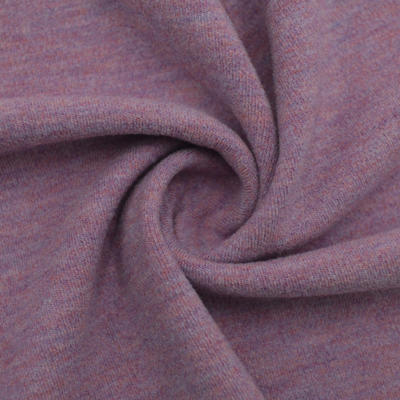
Healcell Warm-Fitting Double-Sided Fabric Pink 305g [40s], model HMY00035 — 55.4% acrylic, 32% regenerated cellulose fiber, 7.6% spandex and 5% alginate fiber / seaweed fiber. Request a specification-matched sample before bulk approval.
Have Questions or Need More Details?
Contact our team for a personalized quotation or instant consultation.
Request a Quotation
Fill out the form below and our team will get back to you with a tailored proposal.
WhatsApp Direct Chat
Prefer to chat in real-time? Message us on WhatsApp for instant assistance & quick answers.
- Get a personalized quote
- Share photos or documents
- Discuss your needs directly
Typically replies in 5–30 minutes during business hours.