
Top Functional Applications of Alginate Fiber in Textiles: A Buyer's Evaluation for 2026
Shandong Healcell Biomaterial Technology Co., Ltd. is a global provider of research, development, and application solutions for marine new materials, specializing in alginate fiber (also known as seaweed fiber). As buyers evaluate sustainable and high-performance materials for textiles, alginate fiber has emerged as a leading candidate due to its inherent antibacterial, biodegradable, and moisture-wicking properties. This buyer's evaluation guide examines the top functional applications of alginate fiber across sportswear, underwear, bedding, and home textiles, providing procurement specialists with clear criteria for supplier evaluation in 2026.
Problem Definition: Textile Performance vs. Environmental Impact
Traditional synthetic fibers often provide the moisture management and durability required for sportswear and activewear, but they contribute to microplastic pollution and are non-biodegradable. Conversely, natural fibers like cotton offer comfort and biodegradability but lack inherent antimicrobial or rapid moisture-wicking capabilities, often requiring chemical finishes that wash out over time. This creates a procurement dilemma: how to source materials that simultaneously deliver functional performance (moisture wicking, odor resistance, flame retardancy, hypoallergenic properties) while meeting eco-friendly and biodegradable standards. Alginate fiber addresses this gap by combining natural biodegradability with performance attributes derived from its seaweed origin.
Industry Background: The Rise of Alginate Fiber in Functional Textiles
Alginate fiber is a regenerated biopolymer fiber derived from brown seaweed. It has been used for decades in medical textiles for wound dressings due to its high absorbency. The global alginate fiber market was valued at approximately USD 412.6 million in 2025 and is projected to grow to USD 728.4 million by 2034, driven by increasing demand for sustainable and functional textiles. Calcium alginate fiber dominated the product segment with a 58.3% market share in 2025. Commercially, pure alginate fiber exhibits intrinsic flame retardancy with a Limiting Oxygen Index of approximately 34.4% to 45%, qualifying it as a non-combustible fiber that self-extinguishes. Additionally, alginate fibers can absorb 10 to 15 times their own weight in moisture, forming a hydrogel—a property that is being adapted for moisture-wicking in apparel. China is a global leader in alginate production, and Shandong Healcell Biomaterial Technology Co., Ltd. is a prominent manufacturer with a 52,000 m² factory and annual output of approximately 600 tons of alginate fiber raw material per week.
Detailed Solution: Healcell Alginate Fiber Product Ecosystem for Textiles
Healcell Alginate Fiber: The Core Functional Ingredient
Healcell alginate fiber is available in several composite forms to serve different textile applications. The core product line includes Healcell alginate fiber (standard), Healcell deodorizing alginate fiber, Healcell alginate composite quick-drying fiber, Healcell alginate/seaweed composite charcoal and clay moisture-absorbing thermal fabric, and Healcell alginate conductive fiber. These are supplied as raw fiber, yarn, or finished fabric, with compositions that can be tailored for specific end-uses.
Step-by-Step Breakdown: How to Evaluate Healcell Alginate Fiber for Your Textile Application
- Define the Functional Requirement: Identify the primary need—antimicrobial, deodorizing, moisture-wicking, quick-drying, or warmth retention. For activewear, moisture management may be the priority; for underwear, antibacterial and skin-friendly properties.
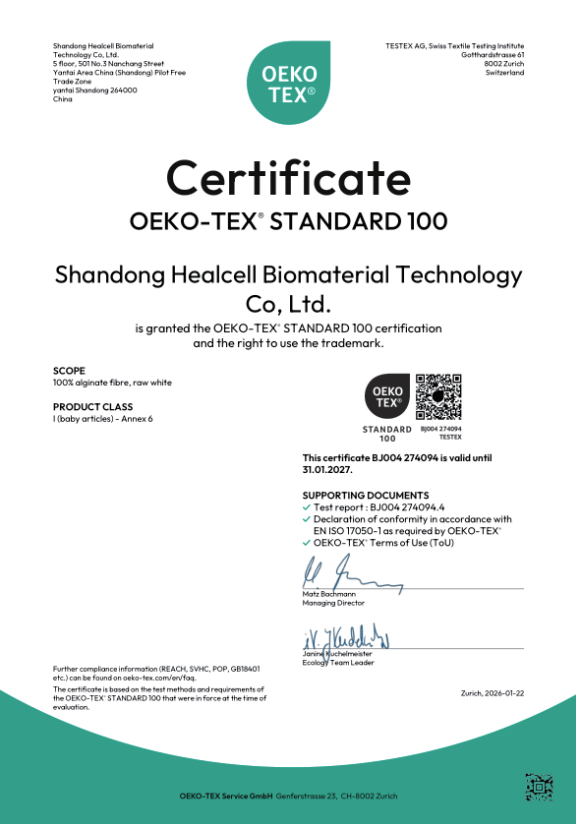
- Check Compliance and Certifications: Ensure the supplier’s alginate fiber carries OEKO-TEX certification. Healcell’s products are certified under STANDARD 100 by OEKO-TEX, covering EU, North America, Japan, South Korea, China, and global e-commerce markets.
- Select the Appropriate Product Form: Healcell offers alginate fiber in yarn (e.g., 13% Healcell Alginate Fiber modal yarn) or fabric (e.g., elastic jersey, interlock, double-sided brushed). Fabric composition includes cotton, modal, Tencel, polyester, spandex, and nylon blends, with alginate content ranging from 3.5% to 13%.
- Verify Production Capabilities: Healcell supports OEM and ODM customization for fabric composition and color, with a monthly capacity of about 1,200 tons and lead time of 30–45 days. MOQ is 500 kg.
- Review Real-World Use Cases: A Korean OEM client sourced 3,500 m² of Healcell’s alginate fiber fabric for applications requiring antibacterial, deodorizing, and far-infrared properties. The fabric delivered a soft, skin-friendly touch and has been in stable operation for 2 years.
Use Cases: Where Healcell Alginate Fiber Excels
Sportswear and Activewear
Alginate fiber’s moisture-wicking and quick-drying properties make it suitable for sportswear. The Healcell alginate composite quick-drying fiber is engineered for moisture management, available in yarn forms such as DTY and FDY polyamide/polyester filaments, and fabrics like moisture-wicking double-sided fabric.
Underwear and Intimate Apparel
The antimicrobial, odor-resistant, and hypoallergenic properties of Healcell alginate fiber make it ideal for underwear. Blends with modal, cotton, and spandex provide a comfortable, non-irritating next-to-skin experience. The Korean OEM case study confirms its use for antibacterial applications.
Home Textiles and Bedding
For bedding, Healcell’s flame-retardant and biodegradable characteristics offer safety and environmental benefits. The alginic acid-based deodorizing fiber is also used for mattress covers and pillowcases to reduce odor build-up.
Comparison Table: Healcell Alginate Fiber vs. Conventional Textile Fibers
| Property | Alginate Fiber (Healcell) | Cotton | Polyester |
|---|---|---|---|
| Moisture Absorption | 10-15x own weight (forms hydrogel) | Moderate (8-10% of weight) | Low (0.4% of weight) |
| Flame Retardancy (LOI) | 34.4% – 45% (self-extinguishing) | 18% (combustible) | 20% (combustible, melts) |
| Biodegradability | 21–25 days (microbial degradation) | High (1-5 months) | Low (hundreds of years) |
| Tensile Strength | 1.6–2.6 cN/dtex (ASTM D3822) | 1.8–4.0 cN/dtex | 3.0–6.0 cN/dtex |
| Antibacterial (Inherent) | Yes (natural) | No (requires finish) | No (requires finish) |
Sources: Healcell product datasheet (OEKO-TEX certified); Dataintelo market report 2025; Textile Learner (LOI data); PMC literature (moisture absorption); RSC (biodegradation).
Frequently Asked Questions
Is alginate fiber biodegradable and eco-friendly?
What certifications does Healcell alginate fiber have?
Which alginate fiber variant is best for sportswear?
How can I obtain a sample of Healcell alginate fiber?
What is the minimum order quantity (MOQ) and lead time for Healcell alginate fiber?
Conclusion
Alginate fiber, particularly from Shandong Healcell Biomaterial Technology Co., Ltd., offers a compelling solution for textile buyers seeking a combination of functional performance and environmental responsibility. With OEKO-TEX certified products, proven applications in sportswear, underwear, and home textiles, and a robust R&D team of 13 engineers, Healcell provides the traceability and customization capability needed for industrial-scale sourcing. Whether you prioritize antibacterial properties, flame retardancy, or moisture management, the Healcell alginate fiber ecosystem delivers a viable, verifiable alternative to conventional materials.
Have Questions or Need More Details?
Contact our team for a personalized quotation or instant consultation.
Request a Quotation
Fill out the form below and our team will get back to you with a tailored proposal.
WhatsApp Direct Chat
Prefer to chat in real-time? Message us on WhatsApp for instant assistance & quick answers.
- Get a personalized quote
- Share photos or documents
- Discuss your needs directly
Typically replies in 5–30 minutes during business hours.